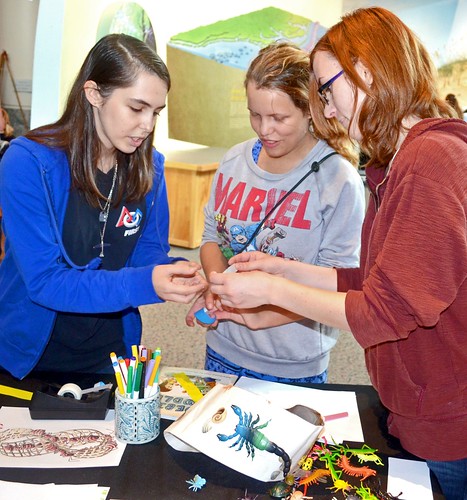
Parents and teachers often ask why we call this or that informal activity “mathematics.” Where is math in a puzzle, game, or craft? This year, we did origami at the annual BugFest, and got this question a lot. Why is origami good for your math?
First of all, try the pattern we used. It’s a cicada, because this year is super-special for cicadas. The broods that emerge every 13 years and 17 years come out together! And how often does that happen, exactly? Wow, what rare event!
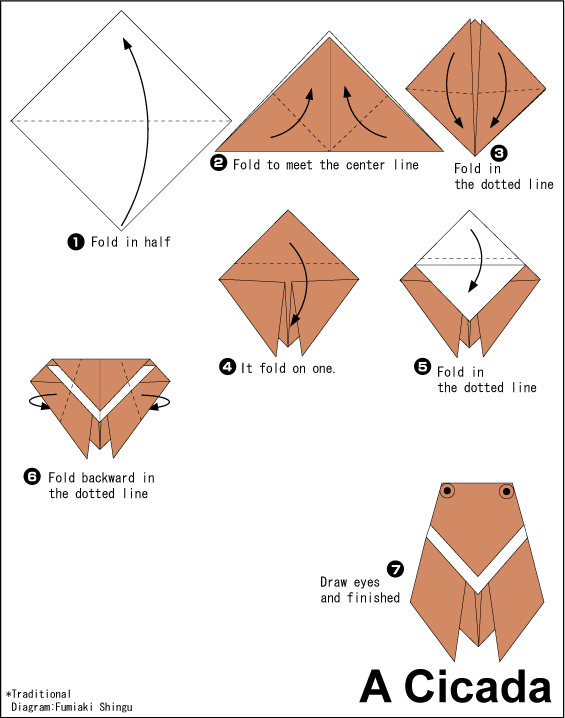
You’ll need a square piece of paper for this, and most paper comes in rectangles. What’s an easy way to make a square piece out of a rectangular paper? Of course, if you aren’t into bugs, you can find an origami pattern for anything you do like – superheroes or Jedi, robots or ponies, flowers or crystals, and so on.
If you’ve folded our cicada or another design, you know it takes a few decisions along the way. Do I use all paper layers or just some? Do I fold up or down? What angle do I choose at Step 7? If you play the (very very challenging) game of explaining an origami pattern by phone, you are sure to use a ton of math-related words. Up and down, triangles and squares, lined-up and perpendicular… When children hear math words in casual activities, it boosts their understanding of the subject. This is just one of the many math benefits of origami:
- If you talk about your origami, you are sure to bring lots of math words into your child’s life.
- Origami gives you hands-on experience of shapes, angles, lines, and geometric transformations. It’s a series of small geometric puzzles!
- Origami is an impressionist art. That’s why the folded piece is not a photo-realistic cicada. Instead, it shows the essence of the shape. This way, origami teaches us the art and craft of mathematical modeling, where you use simple parts to build complex stuff.
- Even young children want their folds to be precise, because nicely folded paper looks pleasant. Precision is a major value in mathematics. Origami teaches precision in a gentle and beautiful way.
- Paper is accessible and cheap. Paper craft invites you to mess with your project as you wish, to make mistakes, and to try this and that. Just like healthy math, where you make your own models, problems, and conjectures.
- Like all good math, origami can take your mind to a happy place. The headspace origami creates is focused and meditative. But when you figure out a difficult fold, it’s a burst of exuberant joy! Once you learn how, you can enter these states of mind to do other types of mathematics.