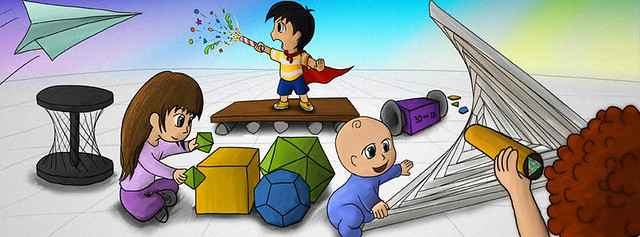
Welcome to adventurous math for the playground crowd! I am Moby Snoodles, and I love to hear from you at moby@moebiusnoodles.com
Thank you for offers to help review the book before it goes out! And for kind words, like these:
Anna Weltman of the Math Munch crew – a group of bloggers who will review together – writes: “I’m really excited, too! I’ve been looking forward to reading your book ever since I found out about it.”
Brendan Murphy, of “Philosophy without a home” offers: “I’d love to help doing reviews.” I also could not help but steal (with attribution) a part of his signature: “You do not study mathematics because it helps you build a bridge. You study mathematics because it is the poetry of the universe. Its beauty transcends mere things.” – Jonathan David Farley, NY Times letter.
We only have two chapters left to lay out and to illustrate. Then we’ll work with reviewers. I am very much looking forward to discussions with all you fabulous math lovers!
I have to confess I love fractals. This is a bit trivial, as confessions go. It is like saying, “I love music, food and holidays.” So does everyone else! Even people who don’t know the word “fractal” have seen, and liked, the ubiquitous pretty pictures.
However, not all of us (humans or whales) realize that much of the math behind fractals is very intuitive. It is the basis of traditional storytelling and the crafts of many tribes. It is also accessible to young kids, even toddlers!
Last week our illustrator, Ever, worked on the chapter about iconic fractals. He wanted to make a tree-type fractal, based on 3 “branches” and made out of creatures:
However, the number 3 is not typically associated with worms. We wanted our 3 to be more iconic, so we used an ant! Ant bodies consist of three major parts. If you want to know, they are called head, thorax (the “chest”) and gaster (the “stomach”).
But wait, there are two “branches” of the tree fractal on the ant’s gaster and none on the head! The ant does have three parts, but they are not used, one-for-one, in the structure of the fractal! The artistic reason was the smallness of the head, which is correct anatomically. And the artistic solution was to “cartoon” the ant, making its head large. I think it’s cute. It also expresses the math we need.
This is the sort of conversation I often have with three- to six-year-old kids. They use stamps or stickers or their own hands to make fractals. What number goes with what image? Where do you “branch” your fractal? How do you keep the pattern? What sizes do you choose for different parts?
Fascinating! The same ideas and thoughts come up in the work of little ones and of grown-ups! These must be deep and lovable ideas. Like music, food and holidays.
Talk to you again on October 15th!
Moby Snoodles, aka Dr. Maria Droujkova

Welcome to adventurous math for the playground crowd! I am Moby Snoodles, and I love to hear from you at: moby@moebiusnoodles.com
There are just a few chapters left to illustrate. This should be all done by the beginning of October, when we start rounds of final reviews. If you would like to participate in reviews, drop me a note!
One of the main ways we make mathematics accessible to babies and toddlers is… symbols.
“Wait, what?” – you may ask. Isn’t symbolic mathematics harder than hands-on work?
It depends on what types of symbols we use. Here are a few examples.
“Baby signs” are hand gestures parents and kids establish for everyday needs of the baby, such as “Bring me that thing” or “More food” or “Pick me up.” Yes, a hand gesture is a type of a symbol.
Have you ever met a toddler who is crazy about horses, or in love with trucks? Anything referring to the beloved topic, such as a saddle or a wheel, will be dear to that child’s heart. Marketers know this and decorate pajamas, pens or backpacks with horseshoes or hot trucks. A saddle is not just a saddle – it’s a symbol of riding, caring for horses, and a whole world of interesting horse-related things!
Kids around the age of four of five often fall in love with particular colors. A child may only want to wear yellow shirts, or to build with yellow blocks and to draw with yellow markers. More often than not, colors have deep symbolic meaning to children. One mainstream example is “pink” symbolizing “ballet” for kids who love to dance. Sometimes these color symbols come from the media. For example, most cartoon characters have their colors, such as Batman and black. Of course, color combinations are symbols for a lot of things too – like green+red for winter holidays, or colors of its flag for a nation.
Here are two examples from the Moebius Noodles book. In the chapter on mirrors, we switched from formal symbols (numbers and multiplication signs) to visual diagrams that are more accessible:
And here are symbols for function machines in this incredible triple composition! Can you guess what the functions do? Three-year-old kids with whom we work can!
“The favorite number of Count von Count from Sesame Street was 34969. Why? And what is YOUR favorite number?” – was our question on Facebook.
Paul Solomon’s answer:
My favorite is 27. 3 is lovely, but this is 3^3. Also, I was born on May 27, lived at 27 Midpark, and other such connections. 27 is for me. :)
Read more on his blog post “Exponents and the scale of the Universe” where this picture can be found. Talk about visual symbols!
Talk to you again on September 30th!
Moby Snoodles, aka Dr. Maria Droujkova

Welcome to adventurous math for the playground crowd! I am Moby Snoodles, and I love to hear from you at moby@moebiusnoodles.com
As Sue VanHattum guessed, my native language is Whalish. And now Ever discovers my favorite color is 33 80 DE. Translated from Whalish (hexadecimal, base 16) into human, these are three numbers:
51 128 222
coding red-green-blue parts of a color. You can see there is not much red (51), but a whole lot of blue (222), mixed with about half as much of lovely green (128). The color of endless oceans and evening skies!
The topic of different number bases was made somewhat accessible to young children in the sixties and seventies of the twentieth century. There are already many games and stories about it. The main thing parents need to know is that young kids love small bases. Base 16, which digital artists use, is no good for toddlers, and neither is, sadly, base 10 that most humans use. Little kids need tiny bases – binary (2), ternary (3) or at most base 5. But this is a not a tiny topic – we will explore it on the blog!
– I thought Moby needed some color, hahaha… I hope you like :) – Ever Salazar
– Thank you, Ever. Not just “some” color, but my favorite color! I like! – Moby
Mathematics is deeply playful. How deeply? It’s fractally playful! It’s playful at every conceivable scale of resolution! Zooming in on any part of any mathematical endeavor finds parts every bit as playful as the whole.
Why is mathematics playful?
How can people who are not mathematicians experience math play?
Both questions have the same answer, which is, in turn, a question: WHAT IF?
If I weren’t a whale and could climb, I would shout “What if?” from the roofs of the tallest buildings, because the world needs more of it. Mathematics is playful because it constantly asks this silly, hilarious, game-like question, “What if?” You can experience math play if you ask this question, a lot. What if you make parallel lines intersect? (Non-Euclidean geometries.) What if you took square roots of negative numbers? (Complex numbers.) What if you divided by zero? (Infinity, which young kids love.)
The chapter we worked on this week is about composition of functions. It uses a lot of animal examples. What if dogs had 8 legs? What if you could reverse time and turn hens into baby chickens? What if you used a spinner instead of a die in your favorite game? Play on!
Mobius strips

Yelena describes storytelling play involving mobius strips, inspired by the lovely Vi Hart video “Wind and Mr.Ug.” We highly recommend the story and the video to you and your kids!
http://www.youtube.com/watch?v=4mdEsouIXGM
Velocity Raptor
http://www.testtubegames.com/velocityraptor.html
From our Facebook write-up: “Lapware: A game about relativity theory, accessible to young kids. Play past level 4 for cool effects that blow your mind! I am sitting here laughing out loud as the dinosaur makes the room around him stretch in bizarre ways as he runs at near-light speeds. Thank you for the link, Chris Hazard!”
Talk to you again on September 15th!
Moby Snoodles, aka Dr. Maria Droujkova
httpv://www.youtube.com/watch?v=4mdEsouIXGM
This is a story inspired by Vi Hart’s “Wind and Mr Ug” video. I so wanted to tell it to my son myself, but my drawing skills fall way short. So instead we talked about ants.
Once upon a time two ants lived on a strip of paper. A strip of paper has… how many sides? how many edges? [I drew two ants on a strip of paper] Each ant lived on his own side of the strip. They never saw each other, but since ants have an excellent sense of smell, they smelled each other. And they really, really wanted to have a playdate or maybe a tea party one of these days. They tried visiting one another, but each time they reached an edge of their little flat worlds and would get scared. Then one day something happened. There was much shaking and twisting and the ants got scared and closed their eyes and covered their heads and tucked their antennas. When the twisting and shaking stopped, they opened their eyes and saw something strange. Their flat world was no longer flat. Instead, it became cylindrical [At this point I glued the edges of the strip together to create a cylinder]
Hooray! said the ants. Maybe now we can visit each other! One of the ants, who was a bit braver and more adventurous than the other, immediately set out on a round-the-world trip in hopes of meeting his friend. He crawled and crawled along, leaving tiny prints behind him [I’m drawing ant’s path with a marker]. Will he ever see his friend? Soon the ant came to a set of tiny footprints. At first he got excited. Was that the marks left by his never-before-seen friend? Is he getting closer? But soon the ant realized that those were his own prints and he’s been crawling round and round his little world. But what about the other ant? He too sat out on a journey, crawling along. Will he have better luck? [I’m drawing second ant’s path with a different colored marker]. Nope, he too finds no one, just his own footprints. Their world had… how many sides? how many edges? Poor tired ants needed a rest. But just as they were going to take a nap, their cylindrical world shook and twisted again. Again they got scared and closed their eyes and covered their heads and tucked in their antennas. [Here I cut the cylinder to turn it back into a strip; then I twist the strip and glue to form a Moebius strip]. When the twisting and the shaking stopped, they opened their eyes and looked at their strange new world. Maybe now that it changed they will be able to meet each other. The first ant, the braver one, set out on his round-the-world trip once again. He walked up the hill and down the hill and across the valley [I’m tracing the ant’s path with a marker] until… he saw the other ant! Hooray, the two cried and hugged each other. And then they walked back to the first ant’s home [a child is tracing the ants’ path with a different color marker]. Their world was no longer flat. Was it a cylinder? Nope, it became something called a Moebius strip. How many edges does it have? How many sides?
And that was the story. But then we experimented some more. We made another cylinder and another Moebius strip, each with its own pair of ants. This time my son traced ants’ paths all by himself. Then I brought out the scissors and both worlds underwent another cataclysm, this time it was a continental drift (thanks, Ice Age 3, for the idea) as I cut the cylinder and the strip in half. Want to know what happened to the ants? Try it for yourself. It’s really very fun!