
Playing With Math: Newsletter July 1, 2014

Subscribe to newsletters
Pinterest | Twitter | Facebook | Google+
Hi, I am Moby Snoodles, and this is news about Natural Math.
Send me your questions, comments, and stories of math adventures at moby@moebiusnoodles.com

Playing With Math

We at Natural Math are at it again: producing and publishing an innovative, playful, Creative Commons book, crowdsourced and crowdfunded. Playing With Math: Stories from Math Circles, Homeschoolers, and Passionate Teachers is edited by our Sue VanHattum, with more than fifty people contributing stories, art, puzzles, and lots of math love. You can read more details and contribute to the campaign at IncitED.
This is a much anticipated book, about five years in the making. That’s why there are a lot of excited reviews, and more than half of the target amount collected in just the first week of the campaign. I would like to share quotes from a few of my favorite reviews:
To know Sue is to know that she loves teaching and learning mathematics, and she loves writing, therefore this book — this work of consummate love — has to happen. Playing With Math is really a collection of love stories because the authors, including yours truly, want to share something we’re pretty crazy about. It’s the stuff we do beyond the regular school day — we play with math after hours, at the dinner table, on a napkin at the coffee shop, with our own child or with a neighbor’s child, at a family picnic, with our in-laws whom we don’t even like. – Fawn Nguyen, math teacher
“Math-play adventures.” What an inviting phrase. What a promise, what a fundamentally different, and desperately needed vision of what we could be teaching when we teach math! If play is important to you, if learning, if your children are important, this book could restore your hope, or at least reassure you that there are alternatives, effective, tested, and meaningfully playful alternatives, alternatives that you and your children’s teachers can put into place, immediately. – Bernard De Koven, researcher and author
Each chapter of Playing With Math is written by someone not very different from you: parents who have formed kids’ math clubs, homeschoolers who foster math enthusiasm, and teachers who use math in unexpected ways. The book includes puzzles, games, and other activities as well as a wealth of online resources. It also offers something more vital. The real-life experiences shared by the book’s 30 authors enlarge our vision of the role math can play in our lives, one that’s joyfully creative as well as purposeful. – Laura Grace Weldon, author and GeekMom editor
1001 circles: your math adventures
Bill M. from Chicago emailed about trying out different symmetry activities with his twins: “My two 4-year old girls did not really dig the “symmetry miming exercise” [from the Moebius Noodles book – Moby], but I found something that they enjoyed: folding up paper towels (by squares, by triangles) and dipping each corner into colored liquid. We used water and food coloring like tie-dye. The result was colorful and symmetrical. We could play with symmetry across the various axes and try folding into various shapes to see how it would, literally, unfold. A tip: use lots of food coloring to make rich colors. ”
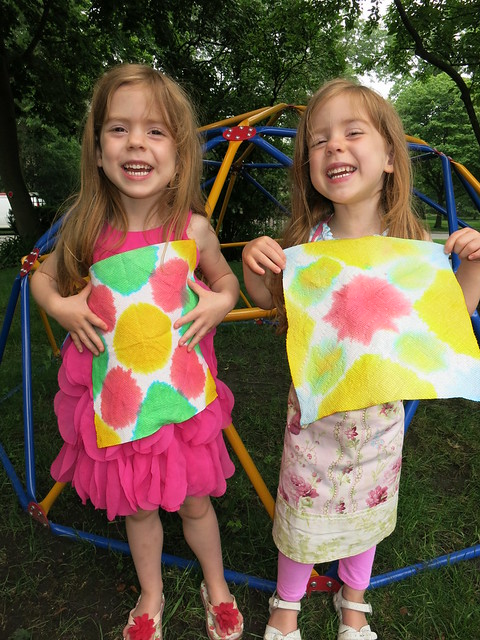
I love to see kids laughing out loud because they are happy about their math! Check out the cool 3D mesh climbing structure in the background, for body-scale math adventures.
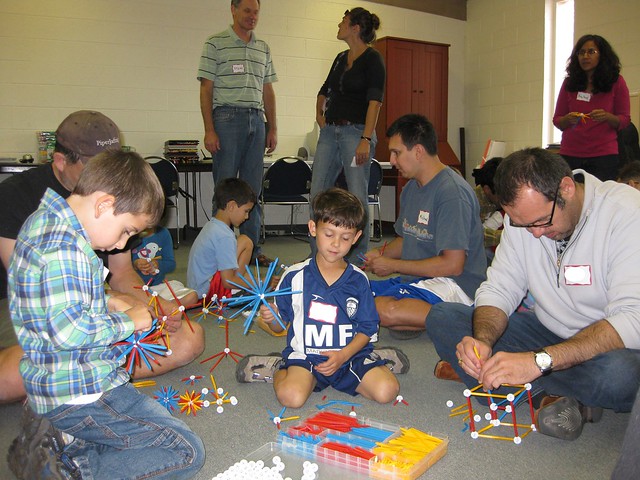
Stephen Taylor is an enthusiastic dad who happens to be an engineer and loves math. Read his guest post for our blog, sharing detailed know-how about running Zometool workshops. Want to try leading your first group event? A one-time, free-building workshop for your children’s friends or classmates is an excellent format. Stephen writes: “I chose a workshop format of “discovery learning” in which just enough guidance is provided to the kids to stimulate their own thinking and creating. I wanted the setting to be very “real world”, like an architect’s studio or a scientist’s lab.”
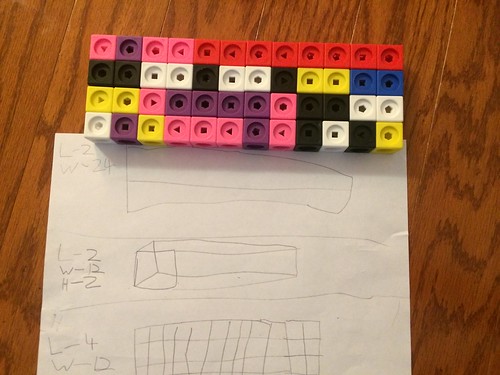
Naveen posted a question to our Ask and Tell forum: “I had asked a open question to my 7 year old son and asked him to make a rectangle with 48 pieces of snapping cubes. He came up with lots of fun ways and really enjoyed it. Would anyone have suggestions for open challenges with the snap cubes?” Answer Naveen’s question, or see what ideas others shared.
Sharing
You are welcome to share the contents of this newsletter online or in print.

Talk to you soon! Moby Snoodles, aka Dr. Maria Droujkova
Posted in Newsletter
Math mind hack: Mention these things to make your kids instantly lose their math abilities
We’ve all been there: you feel especially smart and funny when talking to a particular person, only to feel hopelessly unintelligent and inarticulate in the presence of another.
Remind your daughter that girls are smart before she starts on a math problem.
Put up a new poster about race in your classroom.
Give your student a compliment about the new haircut.
Good advice? NO! You just shrunk children’s math and science skills by 10-30% or more. This treacherous effect, called stereotype threat, applies instantly and can linger for hours. It is especially strong in people who are already struggling with mathematics, but it even works on math professors.
As more people become aware of the danger, policies change. Our author Rachel Steinig gave an interview to The NY Times and then to Good Morning America about a “No Body Talk” policy at a summer camp. A quote from Rachel:
People really like me for who I am and not what I look like, and people actually pay attention to the sort of person that I am. Your dress isn’t really you, it’s just something you bought. But whether you are a good friend, that’s truly you.
Researchers don’t know yet why the mere mention of appearance, gender, or race makes math harder, but there are two clues. First, being reminded of social issues can induce fear, hence the name “stereotype threat”. Any fear reduces activity in parts of the brain involved in problem-solving. More broadly, studies in social information processing hint that it activates different parts of the brain than mathematical problem-solving does. Even a fearless brain wastes tons of resources switching from graphing a function to pondering how women function in the society.
Should you altogether avoid talking about race, gender, or appearance? Not at all. Kids need to discuss key social issues in their lives. But do keep these social discussions away from math adventures and science explorations. People sometimes make fun of stereotypical scientists who don’t give proper compliments, or wear drab clothes, and ignore other social clues. Maybe muting “social noise” helps you keep your math abilities.
What can you teach kids about protection from this effect? Here are three self-help ideas.
- Anchor your mind in its mathematical state. Let the distraction pass over you, and keep your attention on task. Many mindfulness practices give tools for conscious control of attention.
- Counter fears with value affirmation. Remind yourself who you truly are and what you truly want.
- Help others to learn about stereotype threats. Tell them about this mind hack – but not while they are doing mathematics!

Posted in Grow
1001 Circles: Stephen Taylor’s Zometool Adventures
Have you ever dived into a river, lake, ocean, or pool? Have you ever done it in the dark or with your eyes closed? Much scarier, isn’t it? The prospect of leading a math circle, even a small one – your children and a couple of their friends, can be just as scary. While many people understand what a math circle is, few know what happens during circle time. “There be dragons!”
So we are starting a series of stories that show what a math circle might be like from the point of view of Math Circle leaders. We hope these stories will illuminate, inform and inspire you to lead a Circle of your own. And if you are a Math Circle leader, we would like to hear your story or interview you. Write moby@moebiusnoodles.com!
Meet the leader
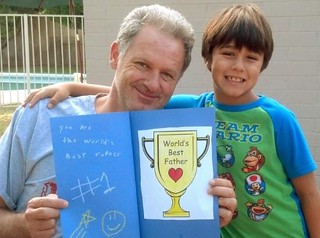
Stephen Taylor is an enthusiastic dad who happens to be an engineer and loves math. His son Kai also loves math and wants to be an engineer or soccer professional. His daughter is a math and reading wizard, and wants to be a doctor like her mom. Stephen has been teaching his kids math since before they could walk, and holding free and open workshops at their school. He loves watching children’s totally fresh approaches to problem solving. This is Stephen’s story about a series of parent and child Zometool workshops, held at a small school for three hours at a time, and centered on open, gently guided building tasks for small teams. The tasks nurture children’s creativity while introducing ideas of multiple dimensions, shapes and symmetry in nature and around town, and mathematics of beauty. A quote:
At their age, talking about many dimensions is no more abstract than talking about long division.
Would you run a workshop like Stephen’s? Read the story and decide!
Zometool Workshops to Stretch the Imagination, Fire up Creativity and Play with a Few Mathematical Concepts
I have always tried to make my brain work better. I know my mother worked really hard at that too. I was the last, by a long way, of five children. By the time I came along my mother knew how to raise a child – she was also a stay-at-home mom, and raising just one kid rather than four at a time was a cinch. She did not send me off to pre-school or kindergarten, but rather she kept me at home as her pal, student, game partner, and gardening hand – I swear we weeded the lawns for a whole year, or so it seemed. The result was that when I got to school, I was far ahead of my peers. Yes, individualized mother’s attention is probably the greatest gift we can give a child. But in today’s crazy busy world that does not seem to happen much. My kids came along, and luckily my wife and I had similar ideas about raising kids. We spent every free moment playing with our kids – board games, construction games, rail tracks, cards, Roulette, Black Jack, Chess, Blokus 3D, Pentago…. and Zometool.
Zometool is an advanced model building tool created to help mathematicians and artists discover form and shape, but is marketed and produced as a toy. It draws you into building domes, bridges, towers, pyramids, stars, fractals, crystals, hypercubes, sunflowers, and almost anything imaginable. It was invented by a crowd of hippie types in Boulder. I had stumbled across Zometool when I studied applied math at the University of Colorado. It is a mathematical tool or toy, depending on how you think. I fell in love with it as the toy (that’s how I think) and squirreled away a set for the day when I would have my own kids. That was rather optimistic thinking for a math nerd without a girlfriend in sight.
But it all worked out! So when my son got to kindergarten in a tiny school battling to attract students and money, I decided to hold Zometool workshops. I made the workshops free, as I just cannot charge to teach children mathematics. I produced a wacky flyer, and the editor at the local rag published a nice article for me.
Photo: The workshop for 5 to 8 year olds (plus parents)
Before long I had mothers emailing me. They had to figure me out: Who is this guy? Why are these workshops free? And what is Zometool? Nearly everyone had the same line of questions, so I prepared a little slideshow for them, describing the workshop.

Picture: the 4D cube animation from the original slideshow
That seemed to do the trick in vetting me. Soon I had over thirty kids signed up, from all walks of life, including a large foster home and five area schools. Now I had to hold four workshops instead of just one. Good for the school, for the kids, for the parents, for mathematics, and at the end of the day, for me.
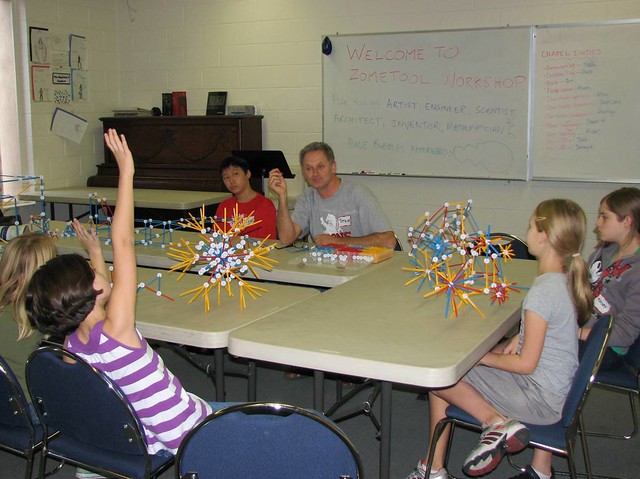
Photo: Studio discussions for 9 to 13 year olds
I chose a workshop format of “discovery learning” in which just enough guidance is provided to the kids to stimulate their own thinking and creating. I wanted the setting to be very “real world”, like an architect’s studio or a scientist’s lab. I also wanted the parents to attend and participate, with the rather mean objective of setting them difficult problems just so that their kids could see them struggle. This is because I believe such struggles show to kids that things mathematical do not just happen magically. People have to wrestle down math problems, to struggle and to pull out their hair. Also, and this is a big plus, the Zometool people promote workshops and send you these gigantic Zometool sets for just the cost of shipping. They also have a paper on how to hold a Zometool workshop.
My theme for the workshops was to stress the links between mathematics and beauty, as well as science and creativity. I also wanted the kids to really discover and learn, to think like they are not taught to think at school, to work as a team, to feed off each other’s ideas. I must say I was somewhat afraid that I could not pull off the whole thing!
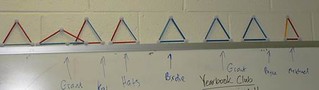
Photo: The triangle challenge – build as many triangles as possible.
I formulated a little plan. I would have the Zometool pieces just lying around on the classroom floor. As the kids and parents came in, I would greet them and say: “The workshop is starting in 20 minutes. Please feel free to play with the Zometool.” No introduction, no “don’t break the parts” routine, no guidance: just discover the tool, in your own way. Luckily none of the kids or parent knew the toy, so it was fresh for everyone. After about 10 minutes, when I saw how engaged everyone was, my nervousness went away. Yes, I could keep them engaged for three hours.
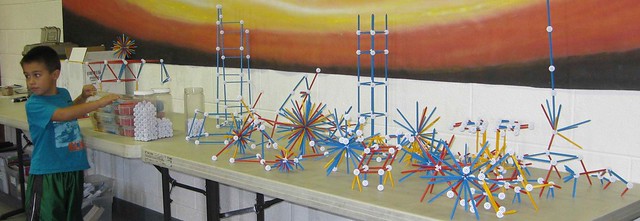
After about thirty minutes I pulled them into the conference area and established the workshop setting. I explained the rules (or lack thereof) for working as a team of collaborators. Everyone was a teacher and everyone was a learner, and, my, did this work! The kids loved it. They contributed, they shared ideas. We had challenges, we discussed the challenges. We also discussed beauty and creativity. We talked about engineers, and artists and scientists, inventors and mathematicians. We spoke about 1-dimension, 2-dimensions, 3-dimensions, and many dimensions. At their age, talking about many dimensions is no more abstract than talking about long division, so this was no real sweat. Dads had to explain how they approached their challenges and their difficulties. And suddenly, there were no parts left. The gigantic sets, with over 4,000 parts had all been used by the kids and parents. This happened in every workshop.
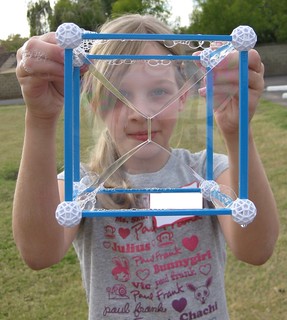
Next, we used the Zometool parts to create frames for making very large soap bubbles. We also played with the cool concepts of minimal surfaces and shapes of rotation. These active outdoor explorations helped to get the wiggles out of the kids before going home.

All in all, I was totally amazed! The kids were outstanding – maybe America’s children do not have a learning problem!
One of the little stars was an eleven year old, who produced one of the most beautiful creations, and was a key member of her team. A week or so after the workshop she was kind enough to write down the answers to some goofy adult questions for In the Zona magazine interview. She described her workshop experience, and the challenge for teams to build a dodecahedron, which was run as a race between teams.
Have you ever attended a workshop before? How is a workshop different from classroom learning?
No, I have never attended a workshop before. A workshop lets you create and discover if different things can happen, instead of just people telling you things and you believing them.
What did you create out of Zometool?
I created a kind of star thing.
Describe some of the other workshop participants’ creations. Did you notice a difference between the boys’ and girls’ creations?
A boy did a box inside a box and a girl did a kind of sculpture. The boys made things that you could tell what they are. The girls did more of just art.
One of the challenges was to create a dodecahedron as a team. Firstly, what is a dodecahedron? Did your team work well together?
A dodecahedron is a twelve-faced shape. We kind of did our own thing until the end, then tried to put it together, but some parts did not work, so we had to take them out.
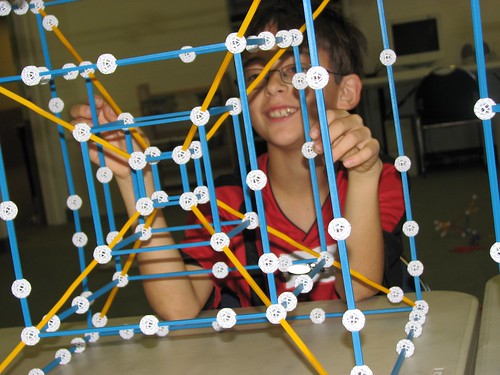
Photo: Cube in a cube in a cube.

Photo: Beautiful mathematical art – “a star thing”.
I felt proud of these little chaotic workshops, and how the kids were so willing to stretch their tiny – no, huge and flexible – minds. This would be a fine story to tell my Mom while weeding the lawn.
Posted in A Math Circle Journey, Make
#littlehousebigmath, and approaching maths backwards: Newsletter June 16, 2014
Subscribe to Moebius Noodles newsletters
Pinterest | Twitter | Facebook | Google+
I am Moby Snoodles, and this is my newsletter. Send me your questions, comments, and stories of math adventures at moby@moebiusnoodles.com

I am still wearing my math goggles from all the scavenger hunts we led at the Raleigh Maker Faire. If you missed it, join us online and at home for the #littlehousebigmath hunt! If you joined us at the Faire, welcome, and good talking to you again! Let’s have some adventures together.

“Bored in a math class” answers surprise the author
One of the questions asked at the Maker Faire was “my child is bored in math class. What can we do about it?” Rachel, a teen helping her mom Rodi Steinig with a book about math circles, asked the same question in several forums around the web: what to do if you are bored in a math class? She says many answers surprised her, but they make a lot of sense:
- Make the best of it by actually trying to change the contents or format of learning
- Ask the teacher for challenges (it’s not a request teachers get a lot in math classes)
- Invent little games and ways of playing, especially about the math in the lesson (Vi Hart’s videos have great examples)
Rachel will share the edited version of the collection in a few weeks – you won’t even have to wait for the book. Add your thoughts to the growing collection on our forum.
Speaking of books
Here is the news from several book projects, by and for the Natural Math network.
Camp Logic by Mark Saul and Sian Zelbo is for those who help children explore the underlying structures of mathematics. It is now in the last stage of reader review, after its crowdfunding campaign collected more than six thousand dollars to cover editing, layout, and printing. Thank you for making the campaign a success! You can pre-order paperback and electronic formats with some bonuses until the book launch in the Fall.
Playing With Math, edited by Sue VanHattum, is about to start its crowdfunding campaign on June 20th. This is a crowdsourced book of stories from math circles, family mathematics, and playful classes – about fifty people contributed chapters, art, and puzzles. It has 300+ pages, the largest of Delta Stream Media book projects to date.

These books will be published under the open Creative Commons license, so everybody can check them out, remix the activities, translate, and otherwise spread the love of mathematics.
The London Mathematical Society published a review of Moebius Noodles, by one of my heroes, Alexander Zvonkin, a pioneer of early advanced mathematics. This is my favorite quote from the review, where Alexander totally gets the main hopes and dreams of our project:
“Sometimes, the authors’ enthusiasm makes them exceedingly optimistic. They say, “In general, the answer to ‘Can young children understand the concept of… ?’ is always ‘Yes!’”, and go on: “But seriously, can you teach any concept at any age?” Apparently, their answer is once again yes. This conviction, if we consider it as a purely scientific statement in the realm of developmental psychology, is certainly wrong. But such ideas should not be judged only as right or wrong. In the first place, this idea is productive. This means that it is not so much a statement as it is a challenge, an appeal to dare, to go ahead without fear and try to invent new activities, new games and circumstances which could eventually acquaint your child with the concept you have in mind.“
Since Moebius Noodles came out a year ago, the Natural Math crew has been working hard to address an aspect the review also mentions. We are now building many more bridges between art activities, free play, games, and other informal mathematics – and formulated, abstract, explicit mathematics. Without such bridges, people who are strong at formal math don’t consider informal activities “real mathematics” – and people who are weak at formal math miss the full richness of mathematical concepts implicit in the activities. These days our materials have stronger scaffolds that help everyone to find, grasp, and share all the deep math behind beautiful art and free play.

For example, this info card accompanied our weaving activity, a hit at the Maker Faire last week. The card gives math terms, whys behind the fun, and an answer to a frequently asked question: “What if my child just weaves randomly, without creating or exploring a pattern?”
Blogs and networks: approaching maths backwards
Sue Elvis at Stories of an Unschooling Family blog writes about her revelation: mathematics can be approached in “the usual” direction of curricular sequences, or backwards, sideways, and every which way. In comments, she says since she started talking about this with other parents, many people came out and said it made total sense:
“I have been surprised at how many people understood what I was trying to say in this post, despite me finding it hard to put it into words. It could be there are a lot of children who work better using a backwards approach.”
I see this trend as well. For example, a recent Y Combinator forum thread discussed graph theory topics Joel David Hamkins presented for his 7-year-old daughter’s class. I love the activities, and what Joel David named his daughter, and the kit for a little booklet on graph theory your kid can make:

Meanwhile, at the Gray Family Circus blog young kids are seen enjoying young calculus activities such as infinite series from our spring online course. Andrea Gray writes:
“I took a great class at Moebius Noodles and got a lot of ideas for hands-on math fun… Mary had the idea for the Colby Car substitution fractal.”

Is your kid like that? Is your child learning algebra before arithmetic, doing long addition left to right, skipping all over Khan academy exercises, or otherwise “approaching maths backwards”? Share your story!
Sharing
You are welcome to share the contents of this newsletter online or in print.
Talk to you soon! Moby Snoodles, aka Maria Droujkova
Posted in Newsletter


