What is one central idea of calculus you would want everyone in the world to understand?
Add your ideas in comments.
What is one central idea of calculus you would want everyone in the world to understand?
Add your ideas in comments.
Lisa G. McCarville is a mother, educator and learning consultant who is working to help people shift their mindsets about what learning is. Lisa is a differently abled person and an advocate for all learners. Lisa works as a writer and an acting instructor/coach using theater games in social groups for people on the autism spectrum. She has a degree in Liberal Arts, 40 years of experience in the arts, and enjoys taking online open courseware classes at many universities. Lisa teaches herself about early education and extensively researches Waldorf, Montessori, and Multiple Intelligence methods of education. She lives with her husband and two big dogs in Arizona, where she homeschools her youngest son, who is on the spectrum. A version of this post originally appeared on Lisa’s blog.
 Skip counting is the main underlying pattern of the multiplication tables. If you count by twos, fives, or tens, you are skip counting. Using a manipulative helps children to see the pattern in an abstract concept like counting by sevens. Why do my son and I use manipulatives? They work for us – it’s that simple. Memorizing multiplication tables is usually done through drills, worksheets and rote memorization. It takes a lot of effort and practice for spatial learners, such as my son. Cognitive research shows that not everyone learns the same way. During my own math education experience, I often had no concrete understanding of what I was memorizing. A manipulative that can be touched allows him to see the abstract connection to what he is memorizing. Creating a visual road map of the “big picture” is crucial to his motivation. He learns where math can take his brain and what he can do with basic math facts. My son is also learning that the effort of thinking is worth the work, that the process of math can be joyful. Montessori classrooms are filled with manipulatives as a part of the curriculum. This wooden manipulative is a Waldorf method used to teach children the relationships between patterns and math. The connection the learner makes with these manipulatives forms a bridge to more complex conceptual thinking skills and hopefully a passionate enjoyment of geometry. This very easily made manipulative for skip counting that I found on Pinterest has become a favorite with many parents on some of the Facebook pages I post on. This manipulative is taken from a traditional Waldorf math lesson done with colored chalk on a board, explaining the relationship of patterns to numeracy. My husband Mike did this project in about an hour, and since I had some of the materials on hand, like the dowels and number stickers, the cost was only the $1.75 used to buy the wooden circle piece at the craft store. I found self-adhesive number stickers at the scrapbooking section but you can use a sharpie, craft paint, or even a watercolor vegetable-based paint, polished down with beeswax to seal and finish it. You can do it on paper as well. I will share ideas about cheaper methods below.
 The Manipulative being used to count by threes.
WHAT YOU NEED
 Mike’s first step was to trace the wooden base onto paper to create a template. He divided the 360 degree circle by 10, which gave him 10 36 degree segments to measure and draw from the center point on the template. He scored through the paper onto the wood, using the pattern to mark where each dowel would go. One of my favorite exercises to do with young children is to imagine how the first humans discovered and recognized a circle. Was it an animal tied to a stake in the ground that made them see the circle shape? How would an animal make a circle like this? String and stick circle making exercises can be introduce how people solved math problems with simple tools. “How did they figure it out” discussions make math fun and engaging for young learners. A wonderful book on these subjects to read aloud to learners is“String, Straight-Edge & Shadow – The Story of Geometry” by Julia E Diggins After scoring the wood, Mike checked his work. This was as hard as it looks but he got it precisely right. An educator could easily turn this into a geometrical problem solving exercise for older children. If they can make a circle, find the center, and divide it into 10 equal fractions, you can even do the patterns with colored pencils on paper circles, leaving out the wood manipulative. Younger learners can use a 36 degree angle template to trace segments onto the circle.
 After the math puzzle is solved and the 10 points are marked it’s time for drilling the dowel holes.
Mike measured the width of wooden dowel against his drill bits, until he found one that matched. He also put a piece of tape on the drill bit to mark how deep to drill, so that he could make each hole uniform. He then practiced on a piece of scrap wood. 
 After Mike drilled out the holes, he used a wood glue to secure the dowels. He also tapped the ends of dowels with a rubber ended hammer to make sure they were secure, and pressed on the adhesive number stickers.
  I like the multiples of three lesson as it shows a wonderful star pattern and the kids love to see how their answers form patterns with the manipulative. Make sure you loop the string around the peg dowels.
  Be aware of how the process works and show the child: if they skip count by 3 all the way up to 3×10 = 30, they can go counterclockwise, skip count by 7 and get the same star. It’s a fun “aha!” moment for kids to discover. I think it is easier to see these patterns with skip counting by 1 and then skip counting counterclockwise by 9. Most kids know number nine has some tricks and it may help them see the pattern. I keep a times tables chart on the table so that my son can reference it and self correct if he gets confused by the numerical language or sequence of what he is doing. This is empowering, and fosters abstract thinking: using rhythmical language, visual cues and hands-on activity across the midline all work together to master the process. Retention of these math facts through visual recognition of the patterns may help students who cannot memorize their multiplication facts in traditional ways. The best part is, it makes math fun while showing patterns in a simple, inexpensive way. Waldorf educators do this circled skip counting on chalk boards too and it is very beautifully rendered. My Pinterest link from above shows examples of this.
 If you use different colored yarn for different numbers you can layer patterns and see common denominators. In these picture, the green string marks threes and the orange marks sixes. My son is very serious here, but he does like this work.
 You can also use a knitting loom as a manipulative. My son said it was like a trampoline and bounced his hand on it!
Another variation of skip counting that my son created with pattern blocks.
The most important reason why I do what I do is these looks of happiness from my son. He loves learning this way. He uses what he learns in his own studies of art, drawing spaceships and futuristic communities using these shapes and patterns. He can synthesize what he learns and make it meaningful to his own interests. My goal is for him to be a lifelong learner and I think that making math enjoyable, practical and engaging leads to that goal.
 Conor’s hexagon space station drawing.
Subscribe and read archives
Pinterest | Twitter | YouTube | Facebook | Google+
Happy holidays from Natural Math!
In this newsletter:
What are you busy with this time of the year? Preparing for the holidays? Remembering all the things you and your family have done this year? Making plans for the new year? All of the above? We are too!
The Natural Math movement is growing – thank you for taking part! Online, through individual projects, and at group opportunities where we’ve invited you to meet and collaborate with other interested and passionate parents, math circle leaders, researchers, authors, and students. Hundreds sign up for the online courses like WOW! Multiplication, participating in crowdfunding campaigns to publish books like Camp Logic, and joining us at large events like Maker Faire, BugFest, SciTech Expo, SPARKcon, and Cary Art Walk. Our materials have been translated into many languages, and people are now reading these words with you live on all continents. Journalists who deeply care about education shared fabulous stories about our work at The Atlantic, Geek Mom, Creative Commons Foundation, and other media outlets.

How can you join these activities, and make them your own? How can you and your children develop meaningful, beautiful, and fun relationships with math? Check out what our community is working on in the next month and beyond.
We plan on making new courses available more regularly. We are asked a lot about multiplication, so we are starting the next year with the Multiplication Explorers, an online course for families and small groups that builds fluency in multiplication as participants adventure in algebra, calculus, arts and sciences. The new and improved course will feature favorite activities tested by hundreds of parents over the years, more videos (including video responses to participant questions!), live Q&A meetings every week at multiple times, updated materials with the latest interactives, and more. It will begin on January 26th. If you are interested, sign up to get more information about the course.
If you or your kids ever wanted to participate in a real scientific research (as researchers, not as guinea pigs), or if you are already a researcher and loving it, then we’ve got something for you! Some of you had met Dr. Melissa Kibbe, a cognitive psychologist studying early algebra, at our Math Future open event. Now we are collaborating even more.
If you have kids ages 4-8 and want to be one of the first to try the Citizen Science Station at Natural Math, apply to be in alpha and beta testing starting in January. The data you gather will help to understand how young minds develop algebra. You will get citizen science training. You will meet Dr. Kibbe and fellow citizen scientists. Your kids will pretend-play an equations game that will grow with them. Watch the video invitation, and beam up to our Station!

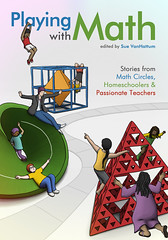
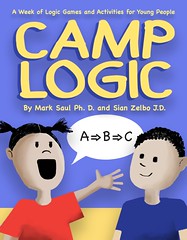
After publishing our first book, Moebius Noodles, we gathered a team of innovative and talented authors, artists, and editors working together to create books that help you make math your own. The two that are scheduled for release in early 2015 and are available for pre-orders are Playing with Math and Camp Logic. Several more are at various stages of production, from the authors working on the first draft to the almost-finished book being at the hands of our beta readers (early reviewers). Email Maria Droujkova if you want to publish with us, or to be an early reviewer helping authors test and improve their work!
We will continue leading local math circles and Math Treks, and sharing stories about them over at Natural Math. Our goal for 2015 is to put together a resource and support structure to help any interested parent, community volunteer, or older student to lead circles and treks of their own.
Natasha Rozhkovskaya’s new book, Math Circles for Elementary School Students is one of few resources for helping young kids work with complex math.
Laura Grace Weldon wrote three blog posts connecting the Natural Math way of learning, meaningful math applications, and math play. The third post has 100+ small pieces that show how these connections work for different families and groups: music and dance, outdoors and sciences…
All of our content is Creative Commons licensed. Most of our courses are pay-what-you-want and for those that aren’t scholarships are available. We encourage sharing and creative reuse of our content as long as it remains open to all. That’s why we had so much fun with Team Open, the new project at Creative Commons that shares powerful stories of using open licenses.
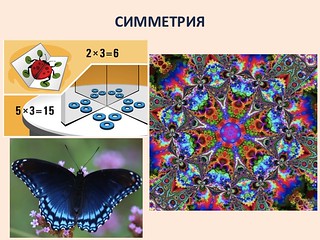
Here’s an example of what open licenses allow. Even if you don’t read Russian, you and your children can enjoy the visual parts in this cool remix of our multiplication models poster by ChildrenScience.
Talk to you next year! Dr. Maria Droujkova and Yelena McManaman

Why are there so few math circles, particularly for younger children? One of the reasons is the belief that very young kids are simply not ready for complex math. Another reason is that finding deep and engaging math activities, adapted for this younger audience, is itself a challenge. Natasha Rozhkovskaya’s new book, Math Circles for Elementary School Students, helps deal with both these difficulties.
The book is based on Natasha’s experience leading a highly popular program for elementary school students at the Berkeley Math Circle. In the true “if you build it, they will come” fashion, the Circle attracted so many youngsters, that it had to be split into several smaller sections. What was originally thought of as a one-semester pilot program is currently in its 3rd year. Its young students return semester after semester to continue learning about such complex modern math ideas as symmetry, fractals, probability theory, logic, knot theory.
Natasha’s book addresses the issue of “too young for this kind of math” early on, in the first few pages. The rest of the book is a delightful collection of activities that deals with the activities challenge – what can young children do during the circle. There are detailed plans and activity descriptions for 28 math circle meetings (15 from the original BMC and 13 from a program Natasha started at the Kansas State University). There’s also something just as valuable as the lesson plans included with the original 15 lessons – Natasha’s reflections and notes on how her students worked through the activities.
In the video, I give some more details about the book and answer a few of Maria’s questions. I highly recommend it, particularly for those math circle leaders who are just starting out or who are starting to work with younger students. You can purchase this book from American Mathematical Society.