From Escher and the Droste Effect
In many ways, graphic art is the visual interpretation of math. Grids are a great example of this.
From the Math in Your Feet blog
Grids are found everywhere in art. In fact, your kid or student may be drawing grids already, like the ones we described in “Do your kids draw grids?” post. If you want to contribute pictures of your kid’s grids, email us at moby@moebiusnoodles.com
Drawing grids involves building two-dimensional shapes using a row and column structure. Visually exploring these two dimensions helps develop spatial and algebraic reasoning.
Grids are a good starting point for understanding two-dimensional shapes, and the same spacial reasoning can be used to give the illusion of three dimensions. By warping grids in parallel with a figure, a person can create the optical illusion of volume where there is none.
From Color, Craft, Create blog
Using nothing but paper, a circular object such as a cup, and a pencil or two, you can introduce your kid to the wild, wild world of three-dimensional volume. The project instructions found here show how you can create the illusion of a sphere by adding parallel lines to the two-dimensional shape.
Using a ruler, a pencil, coloring supplies, and these simple instructions, your kid can easily create an impressive work of art using parallel lines and complementary colors that accentuate the 3D illusion.
A common tradition in kid’s art is drawing hands, so kids will be comfortable tracing their hands in order to do this colorful 3D project.
Because of the use of grids, even kids who can’t draw well will be able to create these vibrant, engaging pictures.
Drawing colorful pictures is a great project that will get your kid excited about even more adventures with math art.

Have fun!

Photo from Technology Rich Inquiry Based Research.
Estimation is a skill everyone uses. You estimate how much cheese is enough for your party, or how long it takes you to drive to your friend’s house. But some people estimate much better than others. Why so? Cognitive neuroscientists Park and Brannon have two pieces of good news you can use.
First, their study confirms that you can train your Approximate Number System (ANS) to improve your guessing and estimation skills. This is not surprising: most math-related skills are trainable. Here is the more exciting, brand-new finding: guesstimating improves your ability to do symbolic addition and subtraction.
From the abstract: This finding strongly supports the hypothesis that complex math skills are fundamentally linked to rudimentary preverbal quantitative abilities and provides the first direct evidence that the ANS and symbolic math may be causally related.
Update: Sheryl Morris commented on Facebook that a Montessori bead version of this mini-poster would work well. Here it is.

Photo from Montessori Album.

Math goggles help you notice math everywhere. Here is something to notice: mathematics is not about numbers, it’s about patterns. When mathematicians deal with numbers, they use systems and formulas. Young mathematicians can start learning this wizardry from simple visual patterns. Here is an elegant game for kids who are exploring quantities. The goal is to figure out the quantity without counting every dot.
Source: Dot cards.
The game is more sophisticated than it looks, because it links three major sources of number: subitizing, unitizing, and counting. Our book Moebius Noodles: Adventurous Math For the Playground Crowd explains why doing so is important. The quote is below, with two examples from the dot card game.


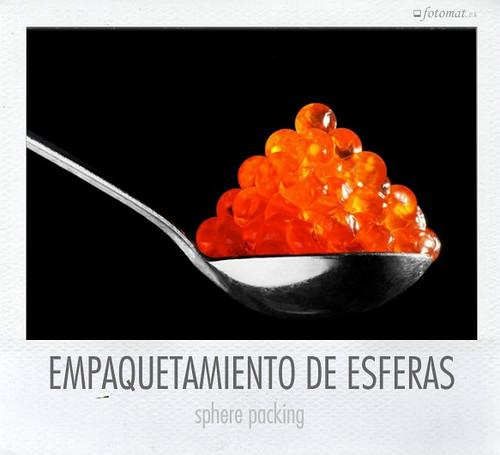
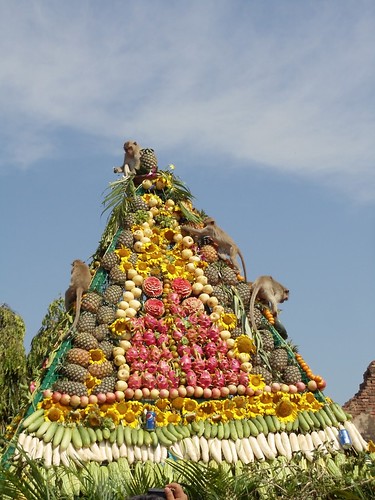
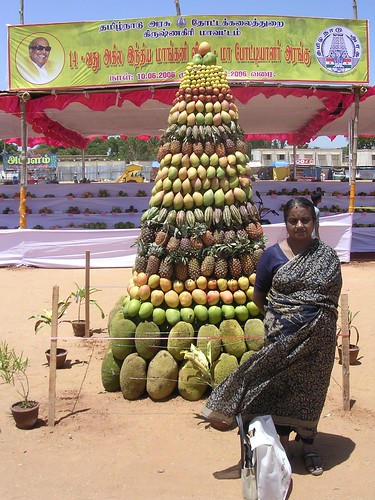
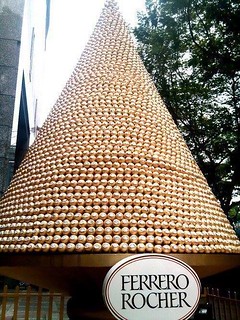
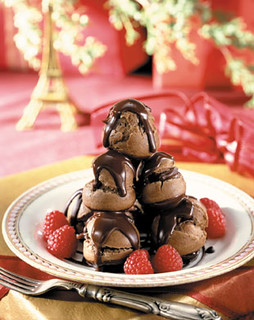
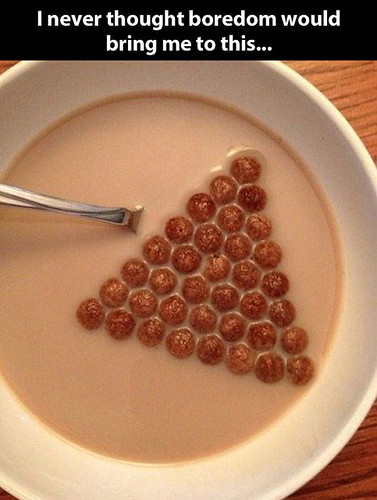
Math goggles help you notice math everywhere. Maria João Lagarto has great math goggles when she makes adventurous Pinterest collections. For this post, I selected examples of round fruits, confections, and other morsels packed into triangles, pyramids, or cones. Even the Wikipedia article on sphere packing uses a pyramid of oranges!

I used to play with a few beads of caviar as a kid, back in Ukraine. Red caviar is a great plaything because of the weird texture and beautiful translucency. But I’ve never managed to build a pyramid. Check out this caviar-inspired, one-paragraph review of 400 years of the history of sphere packing at fotomat.es.
Meanwhile, across the world – in Thailand – there is an annual celebration with an awesome name: Monkey Buffet Festival. It features giant pyramids of fruit for monkeys to enjoy. Yes, monkeys know how to drink out of cans.

They also build giant fruit pyramids in India. This photo is from the All India Mango Festival.

Meanwhile, Europe stacks its chocolates into cones or pyramids:

And Americans play with cereal and pie.


Play with your food – pack some spheres!