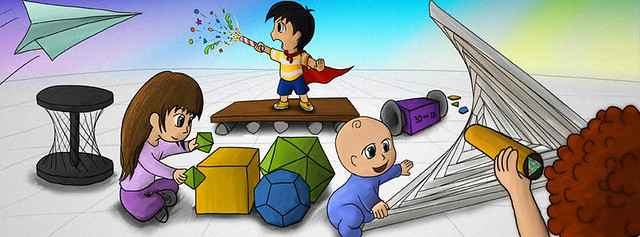
Learning math through the arts… Moby Snoodles approves! So I was happy to review two books from Marcia Daft’s Moving Through Math project. They are read-aloud books for kids under five and their grown-ups. Both books are illustrated in a distinctive, memorable manner that reminded me of early Japanese watercolors. Of math education aspects, I found notes to parents to be most distinctive and memorable. After a strong book, you can graduate from “What?” (what entities and actions were in the book) – to “So what?” (your new understanding of the world).
What? Use iconic symbols, such as clapping hands or shaking maracas, to form pattern units, such as “clap, clap, shake.” Then repeat the unit to form the pattern. Perform each movement as you get to that symbol in the sequence.
So what? Unitizing is the foundation of multiplicative and proportional reasoning. For example, 5*3 can mean a unit of five repeated three times, or a unit of three repeated five times. Kids need to work and play with units a lot, such as repeating parts of songs and dances. A kid who thinks of any unit as a single building block is well on the way to the idea of variables.
Thumbs up!
Building on it

What? A traditional counting book, for numbers from one to ten. Children count by making whole-body movements, such as three giant puddle jumps, seven high reaches to the clouds, or eight jiggles down as you wiggle to the ground.
So what? Fine motor skills use some of the same parts of the brain as mathematics. That’s why activities that require fine motor skills, such as playing musical instruments, crocheting and origami, develop “the math brain.” But you don’t want to overwhelm and overload this math brain. Challenging fine motor skills, on top of challenging new math ideas – that can be too much for one activity! That’s why using gross motor movements helps to introduce new math ideas. Whenever I work with kids, I design whole-body methods for introducing each topic, from equations to infinity. This way, the math brain can devote itself to math, without having to coordinate the fine motor movements too.
Thumbs up!
Building on it
Reviewed by Maria Droujkova
Days are flying by and everyone is busy preparing for the holidays. While you might not know what gift(s) you will be getting this year or whether the kids will catch the sniffles right before the party, one thing you can count on is tangled lights. Seriously, no matter how carefully we pack them, when we open the boxes next year, here they are, all knotted up. Turns out, it’s all about math and physics as opposed to our carelessness. Check out this NPR article for details. Here’s the best part – next time you have knotted up strings of lights, give them to your little one to undo and proudly tell your friends he was busy solving a knot theory problem.

In addition to tangled lights, another thing you can count on is a broken ornament or two or three. If your tree looks a bit bare, don’t rush to the store. Instead, consider some really cool last-minute DIY ornaments. Bonus is they are all about math. The easiest ones are paper chain garlands. This year, add a twist, (ok, half a twist) and turn them into Moebius chain garlands. Or bend pipe cleaners into shapes and grow Borax crystals on them. What shapes you choose is totally up to you. Inspired by Vi Hart’s Borromean Onion Rings video, we made this Borromean Rings ornament.
Or how about turning cardboard boxes you were about to throw away into star ornaments just like Malke and her daughter did on the Map is Not the Territory blog.

Finally, we’d like to share a holiday printable we found thanks to the link from one of the readers, Elena T. She printed it for her daughter to color days ago, but we just got around to it. This Christmas tree might seem like just a giant cute coloring page, but don’t let it fool you. It’s got lots of things going on, including some great math. Can you find examples of gradients, tessellations, pattern, rotational symmetry, radial symmetry, iconic quantities and a lovely Sierpinski triangle?
Share your holiday math with us on the blog and on our Facebook page.
A few days ago I decided to introduce my son to the first of the Sir Cumference books. The entire series is one of the most popular living math books and came highly recommended by quite a few of our math friends. So I sat my son on the couch and told him we were going to read the book about the Knights of the Round Table, something he previously heard about only in a Magic Treehouse story.
I am not sure what I wanted out of it, but a thought of my little one asking me to re-read the story before running off to his desk and feverishly drawing and cutting out shapes did cross my mind. So I was a bit disappointed when he did not ask and did not run off to try it all out with the compass and the triangle. Oh well, maybe he’s not yet ready, I thought.

Except later that day, as my son was playing with his toys on the kitchen table, he asked me “Mom, wouldn’t it be nice if we had a round table in our kitchen?” And that’s how it all started. For a while we talked about the benefits of a round table over our rectangular table. After all, we are a family of three, so we have plenty of room around our smallish table.
My son argued that when grandparents visit, there isn’t much room left and two people have to share one side. And he wanted to see if cutting our table into a circle would make things better.
First we needed to figure out how to find the center of our table which was a nice little geometry problem. It might had been too difficult for him to solve on his own. But I reminded him that he already knows how to find a center of a rectangle because that’s what we do when making origami jumping frogs.
Since we couldn’t fold the table, we had to simulate the folds with some yarn and tape. We then marked the center with a push-pin.
Next we had to figure out how to draw the largest circle we could. The terms we came across in the Sir Cumference story – diameter and radius – came in quite handy in this discussion. My son tried using our compass, but quickly realized it wasn’t big enough. And we didn’t have any round object big enough to be traced. So I showed him how to make a compass with a pushpin, yarn and a pencil. The first few circles we drew were not really circles since we were yet to learn the lesson of keeping the yarn stretched throughout the project.
In retrospect, this was the perfect time to stop and compare the lengths of yarn in taut and slack states.
Once we got a more or less acceptable circle drawn on the table, we needed to make its circumference more visible. I didn’t want to damage the surface any further, so I asked not to use markers or crayons. The only other option was blue painter’s tape. So we brought a roll of tape out, unrolled a long piece and tried marking circumference with it. Except it didn’t quite work.
Which meant we had to figure out how to solve the problem of marking something rounded with something straight. I didn’t think my son would figure it out, but almost immediately he suggested to tear off little pieces of tape instead of one long one. And so we did. We tested different lengths to find a good balance between accuracy and speed. Still, that was a lot of pieces of tape and after a while my son delegated the work to me and simply observed the process. But it was also a great opportunity to recall the Greedy Triangle story.
And then we looked at the finished project and compared the perimeter and area of our would-be round table to our existing rectangular one. It was still big enough for three people, but just about. Trying to fit grandparents was out of the question. So we took the tape off (turns out, it does leave marks on wood, so beware) and decided to leave our table as is.