A couple of weeks ago I discovered a wonderful math blog called Math Munch. Now, with a name like this, you know this is going to be good! And it is even for someone who is not a professional mathematician and who was pretty scared of math as a child (I’m pointing my finger at myself now, tsk-tsk-tsk). Basically, Math Munch is a weekly digest of the beautiful, surprising, strange, engaging, and fun math out there on the Internet.
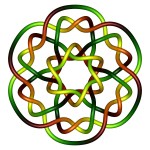
As I was browsing the site, I came across a post about knots. I love knots because they are a) beautiful and b) because I have such a hard time following the instructions and learning how to tie them (something so simple, even a hagfish can do it). Well, I was in for a surprise – turns out, mathematically speaking, the knots we (hagfish and I) usually tie are not really knots at all since the knots we tie are not closed loops.
Intrigued, I followed up with Anna Weltman, who teaches math, folds paper, ties knots and co-authors Math Munch. I wanted to know what kind of activities can I do together with my 5-year old to further explore mathematical knots. Anna’s suggestions were so awesome, that I felt they needed to be shared with you. Note: I added names to each game just because bullet lists are boring. Feel free to rename the activities.
So here is Anna’s response to my question:
A big mathematical question that knot theory is really good for exploring is, “Can I turn this into that without breaking something about it that I think is important?” Another question that knot theory is good for is, “How can I make an object that will do this particular thing I want it to?” I’m not an expert on 5-year-olds, but here are some ideas I had for approaching those two questions through knots:
The Game of Moebius Strip
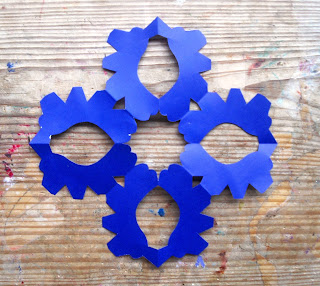
A fun way to make knots and links is to make moebius strips with different numbers of twists and cut them in half. You can make two different knots – a trefoil knot and a knot with 5 crossings – but cutting a 3-twist strip and a 5-twist strip in half, respectively. You can play with cutting differently twisted strips in half and describing the similarities and differences between the results.
The Game of Twisted Cords
Get some pretty slippery string – maybe lanyard/gimp, or headphones (though with only 1 phone would be best). Tangle it up – either haphazardly or methodically, your choice. Then, tape the ends together. Can you untangle it? Untangle it as much as you can and describe what you have in the end. You can do this a bunch of times and keep track of the untangled results. You can then try to make a tangle that you can untangle – ask, what should we do or not do with the ends of the string so that we are sure to be able to untangle it in the end?
The Game of Steer Roping
Get some string and a bunch of differently shaped objects – make sure some have at least 1 hole in them. Challenge your child to tie the string around the objects so that you can’t just slip it off. See if the child can describe what kinds of objects are tie-up-able and what kinds aren’t, and what kinds of tying are best for mastering the challenge. This is less knot theory than it is study of surfaces, but it involves knots!
The Game of Un-Twister
This game is really fun, but you need several people to play it. Stand in a circle. Everybody take hands, but not with the person standing next to you and not both hands with the same person. Then twist and climb and duck under each other’s arms – but don’t let go of each other’s hands! – until you’re standing in a circle again, completely untangled! If you have enough people, it sometimes happens that you end up in two circles. If you want to really analyze the game, you can make a sketch of how everybody took hands and map out the untangling process.
The Game of “I Am Knot Myself Today”
Another fun thing to do along those lines is to try to make a knot out of your arms, torso, and a stick that you can’t untangle without dropping the stick.
httpv://www.youtube.com/watch?v=4mdEsouIXGM
Oh, and Anna pointed me to this great Vi Hart video which seems like a perfect conversation starter.
Awesome applesauce! We’ve already tried the first game Anna suggested and it was a huge hit. I can’t wait to try the rest. Thank you so much, Anna!
If you haven’t done this yet, do check out Math Munch blog. Every single post is chock-full of links to beautiful and engaging math sites many of which could be explored with young children.