
Bojagi: Cute multiplication puzzles by and for families

Multiplication is not just repeated addition, but what is it? From Montessori beads to algebra tiles, many developers claim the array and area models are great for growing children’s conceptual understanding and fluency in multiplication. You can go on scavenger hunts for the area model in tiles and bricks, and draw your own models using graph paper or computers.
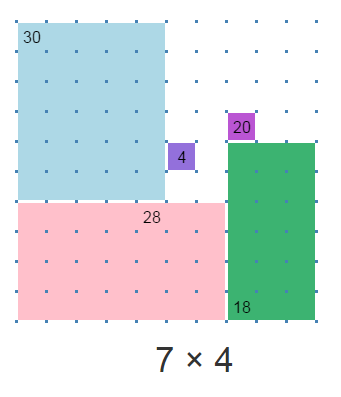
The new puzzle game Bojagi by David Radcliffe (@daveinstpaul) is all about drawing areas. Bojagi’s puzzles make you think, but the rules are easy. Draw a rectangle around each number by clicking and dragging with a mouse. Each rectangle should contain exactly one number, and the area of the rectangle should be the number that it contains. Rectangles must not overlap.
As you draw, the game tells you the two dimensions of your shape, for example, 7 x 4. If you break the rules, your shape disappears. The puzzles provide meditative fun for grown-ups and kids alike. The game helps kids learn multiplication in a gentle, playful manner. Making your own puzzles also feels great: you can draw designs, demonstrate algebraic formulas, or simply play with shapes in open-ended ways. A family or a math circle can take turns designing puzzles for one another.
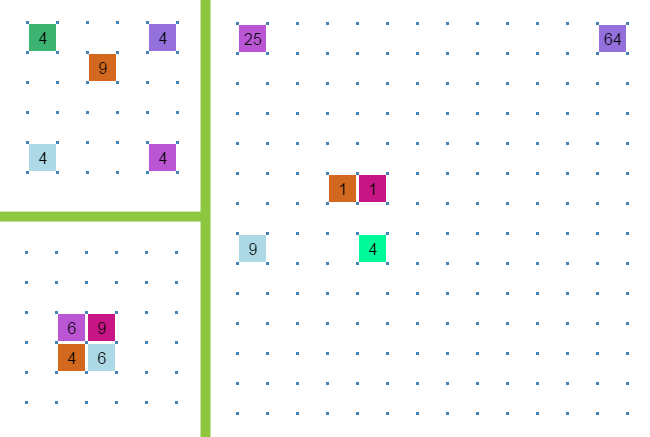
You can find all the puzzles made so far in a big list, and add your own using the puzzle creator. Here are three quick puzzles I made when I first started playing:
- Not Squares has only square numbers, 4 and 9.
- The Fib is about the Fibonacci sequence.
- A Plus B Squared shows the four natural parts of the area that is 2+3 units by 2+3 units.
Bojagi demonstrates these design principles:
- Intrinsic learning. The area model of multiplication is the foundation of gameplay and tactics: you can’t make Bojagi without it. This is in contrast with extrinsic games, where computations are separate from the game mechanics (for example, correct answers let you explode monsters).
- Answer-first approach. You are given the result of the multiplication, rather than numbers to multiply. The task is to “reverse-engineer” the result.
- Strategic problem-solving. Not only do you need to find individual areas correctly, but these areas must also fit the whole puzzle. If they don’t, you have to retrace your steps and try the puzzle again. When solving good math problems, not only do you need to solve each step correctly, as in an exercise, but also to devise an overall strategy that works.
- Make your own math. The puzzle creator supports free play and open design of your own patterns.
Here is my interview with Bojagi’s creator, David Radcliffe.
 Please tell us a bit about yourself.
I am a college math instructor who is changing careers to software development. I graduated from the University of Wisconsin-Milwaukee with a Ph.D. in mathematics. I am interested in finding new ways to use software to help students learn mathematics, especially the tools that encourage exploration and creativity, not just memorization and skill development.
What is the motivation behind your game?
My game presents multiplication in a meaningful context: the area model. I think that it will help students to memorize multiplication facts, but also to understand them visually. It was very important to me that students should be able to create their own levels and share them with their friends, because I want to encourage exploration and play.
Many people say the area model is their favorite model of multiplication. What about you?
The area model is my favorite model of multiplication because it is so easy to visualize. The area model makes many of the properties of multiplication clear, such as the commutative and distributive properties. One weakness of the area model is that it is difficult to interpret multiplication with negative numbers using this model. In that case, I prefer to describe multiplication as scaling.
Your game has a lot of bridges to ideas. Can you name a few?
Besides practicing multiplication facts, the game can be used to explore factorization, divisibility, and prime and composite numbers. A child playing this game can discover that prime numbers can be covered by only one kind of rectangle. Kids may be led to ask which numbers can be covered by two kinds of rectangles. This line of investigation quickly leads to some very interesting concepts in number theory.

(This is a screenshot I took while making a puzzle that can lead someone to explore different ways to factor the same number – MariaD)
Anything else you would like to add, David?
I am a fan of your work with Moebius Noodles, so I am very happy that you are interested in my game. I would be glad to answer any questions that you have. Also, if you have any great ideas for games that I could implement, please pass them along.
Please leave questions and game ideas for David in the comments!
PLAY BOJAGI
Posted in Make
Fractal BugFest, future of learning, math storytelling: Newsletter October 6, 2014
Subscribe and read archives
Pinterest | Twitter | Facebook | Google+
Hi, I am Moby and I bring you the news about Natural Math. Send me your questions, comments, and stories of math adventures at moby@moebiusnoodles.com

In this newsletter:
- Math coloring pages and other activities to try
- Math Future live online meetings for teachers, parents, and teens
- Math Storytelling Day stories
Math coloring pages and other activities to try

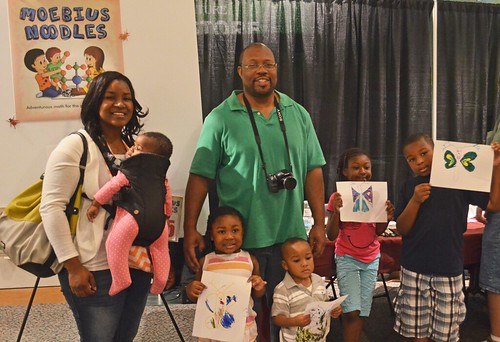
BugFest is a big annual celebration of insects and crustaceans at the North Carolina Museum of Natural Sciences, attracting some 35,000 visitors to its hands-on learning centers – for example, to explore fractals in nature at our table. We miss you already, BugFest friends, and hope to see you again next year! Huge thanks go to the amazing kids who liked our activities so much that they taught them to others. The two most popular activities at the BugFest were insect-themed coloring pages and origami.
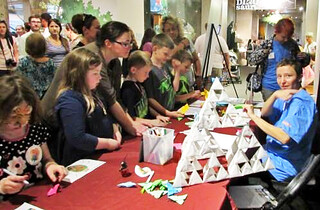
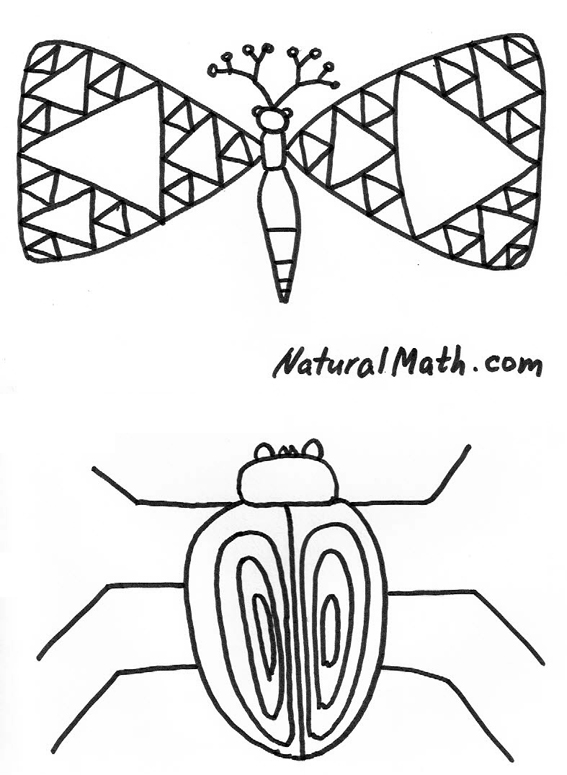
The youngest math explorers and people of all ages who like art can color the Sierpinski butterfly and the Droste beetle, named after the fractal designs on their wings. Or you can design your own fractal fantasy creatures, as visitors did at our table.
Kids develop their intuitions of exponents and infinity with these easy but complex designs. Click to print a larger picture:
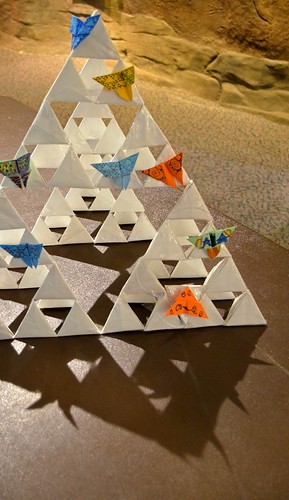
Some visitors wanted to go beyond the flat, 2-dimensional drawings – 1.58-dimensional, to be more precise, in the case of that Sierpinski butterfly. We invited them to fold origami butterflies. As a craft, origami develops several precious mathematical practices directly useful for geometric construction, topology, integration, and analysis of functions – and indirectly for all of math:
- Making shapes out of shapes, and seeing shapes within shapes
- Precision and accuracy
- Reasoning between flat, 2-dimensional medium (paper) and 3-dimensional shapes made out of it
- Decoding words, symbols, and visuals from directions into the kinesthetic experience of folding
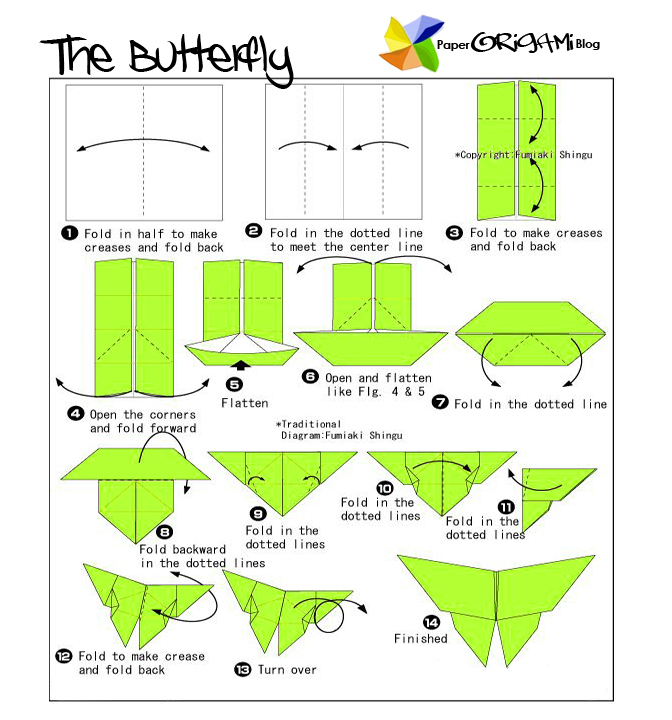
Here are origami symbol and video instructions similar to the butterflies we folded. We skipped shaping the wings at the end (step 10) to make folding easier for the little fingers. Simplifying other people’s patterns is an easy way to start remixing your own origami designs.
This year, FIRST LEGO League world class challenge is, “What is the future of learning?” Two local teams invited Maria Droujkova to talk with them about learning – and once again, she invited kids to fold paper, airplanes this time. The first fold of the paper, just in half, can be explained with just words. As you build the airplane and the folds get more difficult, you have to show the folds, not just tell about them. Toward the very end, you must add the kinesthetic mode of learning to words and visuals. You and your student hold the project together; you guide the folds, so your student can feel how the fold must go. The future of learning is in making your own math – and in using all your senses as you do so.
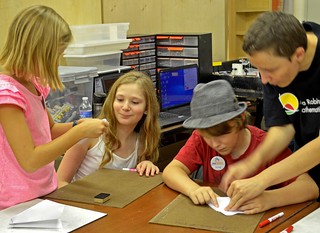
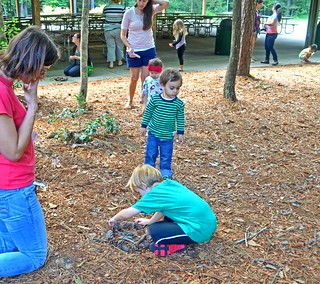
We also came to a playdate with a local parent group called Wee Play. We met the kids and parents at a park, did a Math Trek scavenger hunt, drew some fractals, and made mandalas out of found materials.
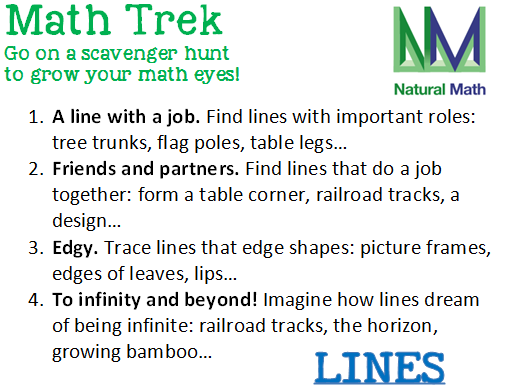
All these activities help to grow your math eyes so you notice mathematics everywhere you go. If you’d like to try a Math Trek, choose a place you like and look for the items listed on the Trek Clue Card (click to get the PDF with 4 copies). Once you find the item, don’t forget to take a picture. You can always share the pictures with us via e-mail, on your blog mentioning Natural Math, or by tagging @NaturalMath on Twitter.
Another big September event was SparkCON, where Maria Droujkova presented a PechaKucha talk called 5 Year Olds Can Learn Calculus. It is a sign of a good connection with the audience when people come up to Maria afterwards and share their math stories – often grief stories: “Let me tell you what happened to me in the third grade!” You can watch the (homemade) video of the talk or look at the slides and the text.
If you would like to invite the Natural Math crew for your events, big or small, write moby@moebiusnoodles.com
For teachers, parents, and teens: Math Future live online events
Math Future is an international network of people who care about mathematics education: researchers, developers, teachers, parents, and students. Since 2009, we have organized more than a hundred live online events with leaders of amazing projects.
On Monday, October 6, at 1 PM Eastern Time, Dr. Keith Still of SaferCrowds.com will introduce his Crowd Sciences work. Learn more and register.
On Wednesday, November 5, at noon Eastern Time, Dr. Joseph Mazur will talk about his new book, Enlightening Symbols. Learn more and register.
Come and listen to short presentations, chat with like-minded people in the audience, and pose questions for presenters!
Math Storytelling Day stories
September 25 was the Math Storytelling Day – thank you for all the stories you sent! Check out these people and groups who joined the fun.
- The Hospital Floor. Denise Gaskins the brave, of Let’s Play Math, shares her thoughts about a semi-random tile wall in her hospital room where she landed with appendicitis.
- Crafting Stories is Juliana Lee’s blog about, well, stories, and she celebrates by reviewing three excellent children’s math readers.
- Bradenton Herald, a Florida newspaper, included Math Storytelling Day in an article by Stephanie Katz about absurd observances, in the excellent company of Talk Like A Pirate Day, our second-favorite September holiday. Arrr! (The official Pirate language page says it means “I am happy.”)
- The Upside Down Triangle author thinks Math Storytelling Day is the best holiday of the year – and posts one of my favorite animated math stories ever, The Cyberchase, to celebrate.
- 4 The Love of Math, a very prettily patterned, pastel-colored blog of Randi Loveland, posts a mini-guide to nerd t-shirts, so you can celebrate in style.
- Awkward Silence Comedy had an improv event staged, described thus: “ASC rides a Mobius strip to the moon! It’s Math Storytelling Day and you know what that means! Bust out those anecdotes about infinite hotels, sketch out some knots, remember that time that grandma forgot to carry the 1. Good times with Grandma, indeed.”
- Math Road Trip Project is a homework assignment that structures a math story around a road trip. How many calculations can you include before your story turns into a non-magical pumpkin, that is, a story problem? Try it and find out!
- Sequence Story Competition was held at Furness Academy, Cumbria, UK. Their intro video has several prompts for writing stories.
This week, we are producing and sending the official Math Maker t-shirts for everybody who ordered or won them. Don’t wait for Math Storytelling Day 2015 to share your story. You can send us a tale of your math adventures any day of the year!
Sharing
You are welcome to share this newsletter online or in print.

Talk to you soon! Moby Snoodles, aka Dr. Maria Droujkova
Posted in Newsletter
Math Storytelling Day: Featuring Carol and the CHS Teen Algebra Club

Today is The Day! March 25th, the Math Storytelling Day is here. And we are sharing with you math stories (in verse and in drawings) sent by Carol and the students at the CHS Teen Algebra Club. Telling stories helps us to understand our students, to make mathematics beautiful, and to reach out to others in the Natural Math community.  Do you have a story to share? Perhaps it just happened today or this post reminded you of something that happened a long time ago. It is not too late to
- Make the word MATH out of objects you and your kids love and use, and take a photo, or…
- Tell us the cute thing your kid did, or math adventures from your math circle, or what happened to you as a child, or…
- Just finish the phrase: “For me, math is…”
Send your pictures and/or stories to moby@moebiusnoodles.com and tell us how to credit your picture: your name(s) and location. For every 20 stories we get by the end of the day today, we will randomly select one. Its author will receive our official limited edition MATH IS WHAT YOU MAKE OF IT! t-shirt.
Carol, the Headmaster of Heroic University, where they celebrate and develop heroes in all disciplines and all walks of life, submitted this limerick:
In my quest for a worthy math hero,
I’m finding who created zero.
Babylon and Mayans,
And then Indians….
Why’s Brahmagupta less known than De Niro?
The students participating in the CHS Teen Algebra Club decided to make the word “MATH” using a grid. So inspiring! Happy Math Storytelling Day to all!


Posted in Make
Boomerangs for peace, a cognitive experiment to try, math stories: newsletter September 16, 2014
Subscribe and read archives
Pinterest | Twitter | Facebook | Google+
Hi, I am Moby from the Moebius Noodles project, bringing you the news about Natural Math. Send me your questions, comments, and stories of math adventures at moby@moebiusnoodles.com
In this newsletter:
- Easy to make boomerang – try it at home to join a global project
- A cognitive science experiment with your kids, or grown-ups
- But you can split any number if you have a knife! Math Storytelling Day is September 25th – share your story!
1001 circles and leaders: Boomerangs for world peace
Professor Yutaka Nishiyama(西山豊) seeks mathematics in everyday life and in cultural traditions. How does an egg roll down a slope? Why do French, Japanese, and Indian people count on their fingers in such different ways? Why do boomerangs fly? Yutaka finds out through research so playful you can follow it with your kids. I love how his accessible explorations mix childlike curiosity, the DIY spirit of making, the scientific experiments – and global sharing. In 1999-2007, The International Boomerang Project for world peace translated instructions for making simple paper boomerangs into 70 languages, making it accessible to 99.99% of the world’s population.

Make your own paper boomerangs with easy instructions from Yutaka, or leave a comment for him on our blog: https://naturalmath.com/2014/09/1001-leaders-make-and-fly-boomerangs-with-yutaka-nishiyama/
Babies, young kids, and even grown-ups can use their Approximate Number System for algebra
This week, we interviewed Dr. Melissa Kibbe about her cognitive psychology research with young children. Dr. Kibbe answered some questions for our blog, and then came to our virtual studio for a live event in the Math Future series. She writes:
Infants, children, adults, and some animals all have a built-in approximate “number sense”. We use this number sense whenever we want to, say, compare which of two jars has the most jelly beans or when we want to estimate how many people are in a crowd. We asked whether children could harness their approximate number sense to solve the kinds of problems that are usually not introduced much later in formal schooling, and with which children often struggle. That is, we thought that presenting problems in a more intuitive way may help kids “solve for x”.

You can try this experiment at home. In our studies, we show children problems with unknown addends (like 5+x=17), but we present them in an intuitive way, embedded in a story. Children saw a stuffed animal character, Gator, who had a “magic” cup that will add more objects to a pile of objects, such as buttons or pennies. Children get to see the piles before the cup added its quantity, and after. We showed children the “magic” cup working on different piles, but always adding the same amount every time. Then, we pretended to mix up some cups, and showed children the quantities inside two different “magic” cups, only one of which matched the quantity that Gator’s cup had added; children were asked to choose which cup belonged to Gator. Children were quite good at choosing which quantity was in the animal’s cup, showing that they had an intuitive sense of the quantity of the unknown addend. Parents can try these kinds of activities with children at home, using items that are found around the house and a favorite toy.
Math Storytelling Day September 25: some stories!
Celebrate Math Storytelling Day by sharing your math stories, big or small. One in every 20 people who submits a story before September 25th gets a Math Maker t-shirt.
In this story, Irina caught her daughter making her own mathematics – namely, her own definition of a key idea:
My six year old daughter Alexandra loves math.
She also loves apples and sweets, and occasionally is willing to share food with her brother. In May we have discussed how we can fairly split up pizza, pies and apples between 2, 3, 4 and more persons. What if one person donates his share for others? Alexandra quickly grasped the concept of fractions and started playing with them in her head.
One month ago we were reading and doing exercises from a book called, What Should I Know Before I Start School? One chapter tried to introduce types of numbers: those in blue boxes (1, 3, 5, …) were odd and those in orange boxes (2, 4 ,6, …) were even. “If you have an even number of items, you can split them evenly in two groups” – the book said to my bitter disappointment.
After some thinking, my daughter came up with a new definition: “Even numbers of apples and sweets can be easily and fairly between me and my brother without cutting. For odd numbers of apples, we would need a knife.”
We are posting stories and pictures to our blog. Send us your stories, big and small!
Sharing
You are welcome to share this newsletter online or in print.
Talk to you soon! Moby Snoodles, aka Dr. Maria Droujkova
Posted in Newsletter


