
Math Storytelling Day: featuring Sheryl, Irina, Anna, and Jevanyn

Today, we share with you math stories sent by Sheryl, Irina, Anna, and Jevanyn. Telling stories helps us to understand our students, to make mathematics beautiful, and to reach out to others in the Natural Math community.

To celebrate Math Storytelling Day on September 25, we invite you to share your stories! Here’s how:
- Make the word MATH out of objects you and your kids love and use, and take a photo, or…
- Tell us the cute thing your kid did, or math adventures from your math circle, or what happened to you as a child, or…
- Just finish the phrase: “For me, math is…”
Send your pictures and/or stories to moby@moebiusnoodles.com and tell us how to credit your picture: your name(s) and location. For 10 more days (till the 25th), every time we get 20 submissions sent to us, we will randomly select one, and its author will receive our official limited edition MATH IS WHAT YOU MAKE OF IT! t-shirt.
Sheryl Morris arranged the word MATH out of her favorite objects-to-think-with:

Irina Malkin Ondik caught her daughter making her own mathematics – namely, her own definition of a key idea:
My six year old daughter Alexandra loves math.
She also loves apples and sweets, and occasionally is willing to share food with her brother. In May we have discussed how we can fairly split up pizza, pies and apples between 2, 3, 4 and more persons. What if one person donates his share for others? Alexandra quickly grasped the concept of fractions and started playing with them in her head.
One month ago we were reading and doing exercises from a book called, What Should I Know Before I Start School? One chapter tried to introduce types of numbers: those in blue boxes (1, 3, 5, …) were odd and those in orange boxes (2, 4 ,6, …) were even. “If you have an even number of items, you can split them evenly in two groups” – the book said to my bitter disappointment.
After some thinking, my daughter came up with a new definition: “Even numbers of apples and sweets can be easily and fairly between me and my brother without cutting. For odd numbers of apples, we would need a knife.”
Several pages (and days) later, she was asked to fill in the blank in this number sequence:
1, 3, 5, __, 9, 11
When I asked her how she has solved the problem, Alexandra replied: “It was easy. Those were odd numbers.”
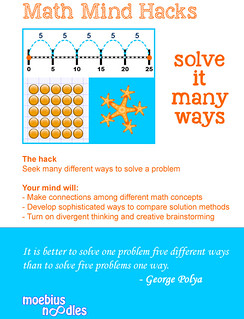
Anna Kuchment invited her daughter to check out our Math Mind Hack mini-poster. Anna had a question: “How do you discuss this with your child? Do you ask how do you find the area of this square, or what is five times five?” – and her daughter helped. You get such surprise gifts as an attentive parent open to child’s ideas! Anna writes:
I went ahead and showed this to my 8 year old daughter, and she had so much fun with it. I didn’t notice the five fives on the starfish, but she picked them out right away. I think the lesson here is that children are far more fearless when it comes to math than most non-STEM parents! Lesson learned.
Jevanyn shares a story of turning mundane homework exercises into a mini-investigation of patterns:
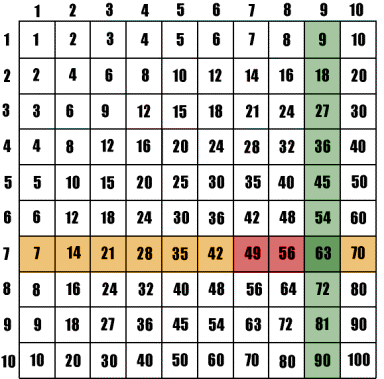
Like many 3rd graders, my son is trudging his way through the times tables, learning multiplication and division the old-fashioned way. Tonight’s homework included:
56 / 7 = ?
and
49 / 7 = ?
Aaaand apparently they haven’t actually reached the sevens part of the times tables yet, or they have and he’s mentally blocking it because ermagrd homework.
So the goal here is to help him find the answer without telling him outright. I start (probably not helpfully) by asking him how far apart 56 and 49 are. So he counts up from 49 to 56, and gets 7. We’re getting somewhere.
Now I say, “So if 56 is some number of sevens, and 49 is some number of sevens, and 56 is one more seven than 49…” He nods his head because he doesn’t know yet where I’ll take this. “Then when you get the answer for 56, the answer for the other is one less. When you solve one, you solve the other.”
This he understands, and he says, “Because 49 and 56 are next to each other on the sevens line.”
So now I ask him what 9×7 is, and everything snaps into place. He sees the pattern behind multiples of seven and gets the answers to the original problems. And he already knows 9x(whatever) because 10-1 is another pattern.
Posted in Make
Interview with Dr. Melissa Kibbe: cognitive psychology of kids ages 4-6 learning algebra
 Dr. Melissa M. Kibbe is assistant professor of Psychological and Brain Sciences at Boston University. She received her PhD in Cognitive Psychology from Rutgers University in 2011, after which she completed postdoctoral research at Johns Hopkins University. Dr. Kibbe’s research focuses on how infants, children, and adults represent information about objects (e.g. perceptual features, animacy, group statistics, numerosity, verbal labels). She also studies how infants’ and children’s early understanding of objects and numbers impacts how they learn formal systems, such as mathematics and physics, later in life.
Meeting with Dr. Melissa Kibbe on September 15
We held an open, free online event in our Math Future series on September 15 8 PM Eastern Time, where we met with Dr. Melissa Kibbe to learn the latest research on early algebra: how children ages 4-6 can use their Approximate Number Sense to “solve for x”.
Here is Melissa’s short interview for readers of Moebius Noodles.
Can you share an anecdote or an episode about math from where you were a little girl?
At my elementary school, there was a path from the crosswalk to the school that made a 90-degree angle. But the kids would walk across the grass to take a shorter path, creating a well-worn dirt hypotenuse. Every day, I would vary the path I took, trying to match my speed to the children walking the other paths, and then I would observe who got to the end of the path first. I was trying to figure out the relationship between the legs and the hypotenuse of the right triangle using experimentation. While I didn’t derive the Pythagorean theorem from my daily experiments, I did get an approximate sense of the proportion of the length of the hypotenuse to the lengths of legs. That kind of experimentation helped to learn the formal rules of trigonometry later on.
What made you study 5-year-olds doing algebra, and other young math?
Infants, children, adults, and some animals all have a built-in approximate “number sense”. We use this number sense whenever we want to, say, compare which of two jars has the most jelly beans or when we want to estimate how many people are in a crowd. We asked whether children could harness their approximate number sense to solve the kinds of problems that are usually not introduced much later in formal schooling, and with which children often struggle. That is, we thought that presenting problems in a more intuitive way may help kids “solve for x”. In our studies, children did not have to count or use symbols. In fact, when we did show them problems with digits and operator-signs, they did quite poorly. Rather, they could rely on their approximate “gut sense” of quantities to solve for the hidden addend in our problems.
Can you share some algebra-inspired activity our readers can try with their toddlers or young kids? What are your personal favorites for when you work with kids, and why?
In our studies, we show children problems with unknown addends (like 5+x=17), but we present them in an intuitive way, embedded in a story. Children saw a stuffed animal character, Gator, who had a “magic” cup that will add more objects to a pile of objects, such as buttons or pennies. Children get to see the piles before the cup added its quantity, and after. We showed children the “magic” cup working on different piles, but always adding the same amount every time. Then, we pretended to mix up some cups, and showed children the quantities inside two different “magic” cups, only one of which matched the quantity that Gator’s cup had added; children were asked to choose which cup belonged to Gator. Children were quite good at choosing which quantity was in the animal’s cup, showing that they had an intuitive sense of the quantity of the unknown addend. Parents can try these kinds of activities with children at home, using items that are found around the house and a favorite toy.

Some people say only some demographics can do early algebra – gifted kids, children of STEM professionals, richly supported kids… What do you say to that?
In our studies, children needed only to rely on their gut-sense of number. Since the children were between 4 and 6 years old, only a few of them had been introduced to formal math in school. Our studies suggest that the ability to “solve for x” is present early in development.
Anyone can try this with kids!
Posted in Grow
1001 Leaders: Make and fly boomerangs with Yutaka Nishiyama
Professor Yutaka Nishiyama(西山豊) seeks mathematics in everyday life and in cultural traditions. How does an egg roll down a slope? Why do French, Japanese, and Indian people count on their fingers in such different ways? Why do boomerangs fly? Yutaka finds out through research so playful you can follow it with your kids. I love how his accessible explorations mix childlike curiosity, the DIY spirit of making, the scientific experiments – and global sharing. In 1999-2007, The International Boomerang Project for world peace translated instructions for making simple paper boomerangs into 70 languages, making it accessible to 99.99% of the world’s population.

Photo: Yutaka Nishiyama with a variety of boomerangs, 1992
In our 1001 Circles series, we feature math circles stories from the point of view of a circle leader, who acts as an invisible tour guide. In the companion series 1001 Leaders, we put the spotlight on the leaders themselves. What got them started and what keeps them going? What are their math dreams and worries? If you lead a math circle, an engineering club, or an informal playgroup, we would like to hear your story or interview you. Write moby@moebiusnoodles.com to talk about your adventures. Here is the interview Prof. Yutaka Nishiyama gave for the series. When Yutaka works with kids and adults from all over the world, the activities center on simple curiosity about objects from the daily life. Try this technique with your kids!
How did you start working on mathematics? How did you get interested in topics such as boomerangs and direction of writing in different languages?
When I was young, I liked math – or rather, I needed math, like I needed eating. I studied math earlier than my friends did, and I was bored with math textbooks at school, and with my math schoolteachers.
Math is hidden everywhere in the daily life, but nobody notices it. I have always enjoyed finding interesting math themes in the daily life. Most people might say that the boomerang is about physics or aerodynamics, not math, and direction of writing is about linguistics, not math. For me, whatever I feel or think is math, or can be math. There is Math of Egg Shapes, Math of Fans, Math of Languages and so on. Math is unlimited! We, teachers and kids, have to go out from math textbooks and into the world.
I started to ask questions about boomerangs when I was 10 years old, and started to study Math of Boomerangs at 30, in 1978. In the summer of 1978, it was very hot. I had blinds on the windows, and researched blinds in an encyclopedia. The article about boomerangs happened to be on the same page. It brought back questions I had at 10, and I felt studying boomerangs would be more interesting than studying blinds.
To spread the word about fantastic boomerangs all over the world, I wanted to translate instructions for making boomerangs into 70 native languages. English is a common language, but only 20% of world people can read it. After translations into 70 languages, my interest changed from the Math of Boomerangs to the Math of Languages. How do the ways languages evolved relate to the ways people write? This theme is very exciting for me.
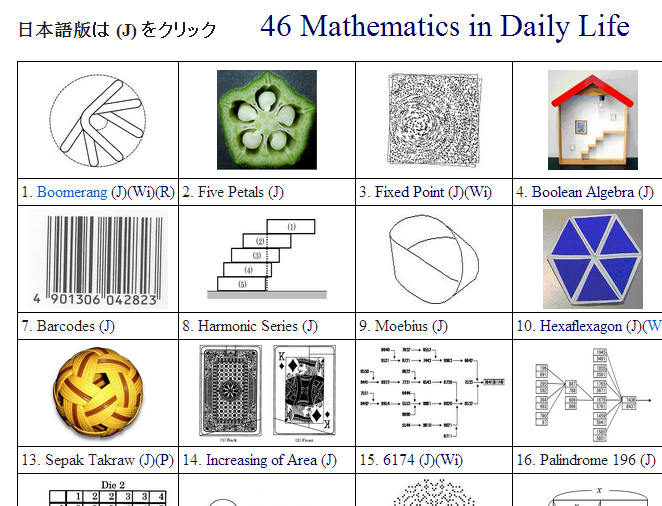
Picture: a screenshot from Yutaka Nishiyama’s site. His new book includes the first thirty articles from this collection – The Mysterious Number 6174: One of 30 Mathematical Topics in Daily Life.
What activity can a family or a math circle do with children, about their native language and math?
Almost all people in the world only know their native language, and believe their language is correct and excellent. Ask kids what is the correct direction of writing. They are likely to answer about their native language. Then you can discuss how there are hundreds of languages on this Earth, and knowing different languages and cultures is useful for world peace. English is written left to right, Arabic right to left, but which is correct? There is no right answer for that question!
In our upcoming book Bright, Brave, Open Minds by Julia Brodsky, there are dozens of “Aha!” problems that sound easy, but lead to wise or funny insights. Yutaka Nishiyama’s simple question, “What is the correct direction of writing?” is a great example of an easy task that leads into deep insights. – Maria D.
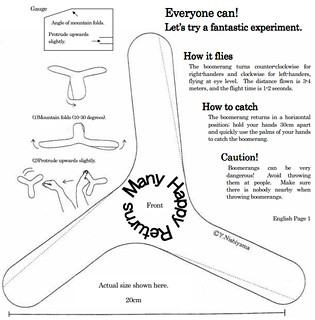
In the Boomerang Project kids learn to make their own boomerangs. How can kids experiment and play around? What variations and variables can they try?
For kids, paper boomerangs are easy to make and safe to fly. Here are some variations:
- Make two copies of the same boomerang and glue them together. How far will that double boomerang fly, compared to the single?
- Make holes at the end of wings. You can hear the whistle. Try different holes.
- Make alphabetical boomerangs, in shapes of letters from A to Z, or the first letter of your name. Whose boomerangs can return the best? X or Y return well, but I does not. O is stable to fly but does not return so well, and so on.
Posted in A Math Circle Journey, Make
Live online events, 1001 Circles, Math Storytelling Day: Newsletter September 2, 2014
Subscribe and read archives
Pinterest | Twitter | Facebook | Google+
Hi, I am Moby from the Moebius Noodles project, bringing you the news about Natural Math. Send me your questions, comments, and stories of math adventures at moby@moebiusnoodles.com

In this newsletter:
- Join us September 3 for a live online Math Future event with leaders of Proof School
- 1001 Circles: five newest interviews with leaders
- Stories for the Math Storytelling Day, September 25
Math Future live online event September 3: What if you could design a school any way you want?
Imagine like-minded parents, teachers, and administrators who deeply care about math. Imagine hundreds of years of their combined experience running math circles, math Olympiads, and family mathematics. Imagine freedom to design the best school you can for the kids of that community. This is what Proof School is about!
Join the open, free online event in the Math Future series. Meet the founders of Proof School, a radical education innovation for children who love math. Listen to a short presentation, chat with people in the audience, and ask presenters questions.

1001 circles and leaders
Try a math circle activity with your kids, or check out what keeps math circle leaders inspired! We are interviewing math circle leaders, experienced and new, with groups large and small, from all over the world. Here are the newest stories in the 1001 Circles series:
- Train your robot with DrTechniko
- An environmental geologist wants to save the world, runs a Math Club
- Jane Kats on game circles and family math camps
- EuclidKids LLC begins as a friend helps a friend’s 5 year old
- Dad and son organize Raleigh Advanced Science Club


If you run a math circle or a family group, or want us to interview a friend who does, email moby@moebiusnoodles.com and we’ll add your story to the 1001 Circles showcase!
Math Storytelling Day September 25: send us your stories!
Celebrate Math Storytelling Day by sharing your math stories, big or small. One in every 20 people who submits a story before September 25th gets a Math Maker t-shirt.
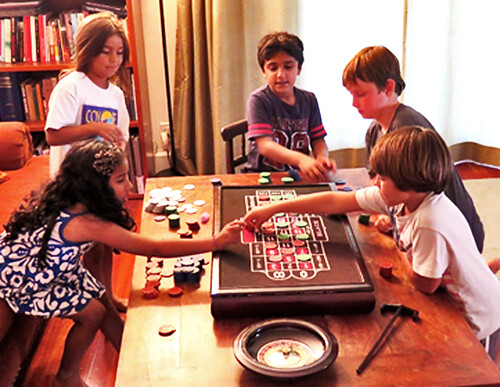
Our first story this year is about a dad who shared his fascination of cost-benefit analysis with his 6-year-old and their friends. They set up a pretend casino, found ways to rig games, and… Well, I will let Stephen Taylor tell you all about their adventure: The day my first grader fell in love with numbers.
Sharing
You are welcome to share this newsletter online or in print.

Talk to you soon! Moby Snoodles, aka Dr. Maria Droujkova
Posted in Newsletter


